There’s coping. And then there’s thriving. It can be really hard to know the difference with pets until you’ve seen it. Owners often expect dental treatment to improve oral health and relieve pain, but they don’t always know what to expect in terms of behaviour and general demeanour afterwards.
We’ve heard it many times: “They’re like a puppy (or kitten) again.” It’s exactly what we like to hear.
At Advanced Animal Dentistry, advanced dental treatments from root canal therapy to oral surgery and full mouth extractions are what we do. We love seeing our patients leave the hospital feeling far better than when they arrived.
Once the underlying problem is treated, improvement can begin remarkably quickly, and before you know it, you might just be seeing a side of your pet you haven’t seen for a while.
Dental disease can change your pet so gradually you barely notice
Unlike an acute injury, some problems don’t appear in an obvious fashion. Even in general veterinary health, for example, a dog with hip dysplasia may deteriorate very slowly, to the point where it looks like it might just be an ageing thing by the time you see a limp. But then X-rays can reveal severe hip disease that’s been developing for a long time. It just wasn’t so easy to recognise the extent of it. Compare that to a dog that goes outside and breaks a leg while playing, and everyone notices immediately from their reaction and behaviour that something is wrong.
Dental disease, including periodontal disease, often behaves similarly. There is usually no sudden emergency or clear red flag. Instead, it worsens little by little over months or even years. Pets can adapt remarkably well to the discomfort this causes, so there may be very minimal outward change. They can still eat despite significant dental pain by altering how they use their mouth. Some may become quieter, less active or less interested in social interaction, but these changes happen so gradually they can easily be put down to ageing or something else.
It’s not just pets that adapt. Owners do too. If a dog becomes slightly less active over a long period, eventually the quieter dog becomes normal. That’s just their dog. And as mentioned, ageing gets the blame for lots of things, so with older dogs, it can be even harder to recognise warning signs when they’re expected to be getting a bit slower and quieter. With cats, they might start hiding more or become less interactive, and their owners can assume, “they’re just being a cat.”
Reduced grooming in felines might be a more noticeable one, but it too can have various causes. It’s important to note that none of these behaviours is proof of dental disease in isolation. But what we do know, and regularly see after veterinary dental treatment, is that these things can change or resolve. That’s when owners may realise the dental problem had actually been affecting their pet all along.
“Sometimes it takes seeing them feeling good again to understand how much they had adapted.”
Treatment can reveal just how much your pet had adapted
Going back to that frequent client sentiment of “they’re like a puppy again”, this is more than just a case of recovering well from the actual surgery, which we’ll discuss later. What owners are describing is a dog or cat that’s brighter, more active, more interactive and interested in doing the things they love again. Sometimes this renewed enthusiasm can be really striking. We’ve even had owners joke that maybe we need to put a couple of those extracted teeth back in because their pet was so lively afterwards.
Beyond the boundless energy levels we might see in dogs, cats can show their improvement by returning to regular grooming and taking better care of their coat. If they’ve been hiding, you might see them come out for social interaction and take greater interest in their surroundings. This can be particularly apparent in cats that have suffered from very painful conditions like stomatitis.
So, what is it about treatment that makes this positive change possible? Veterinary dentistry either removes or addresses the diseased tissue, teeth or other underlying problem. Relief from the associated chronic oral discomfort is naturally part of feeling better afterwards. However, another important factor is inflammation. Chronic inflammation can place the body in a constant state of fighting something it can’t resolve. In the mouth, an animal may have been dealing with this for a very long time. Once the source is treated, that burden is reduced, too.
Most owners understand that treating dental disease is simply the best option for their pet’s health and overall wellbeing. What they don’t always anticipate is how this will translate into a brighter, bouncier or just happier pet.
Even when a pet seemed fine before treatment
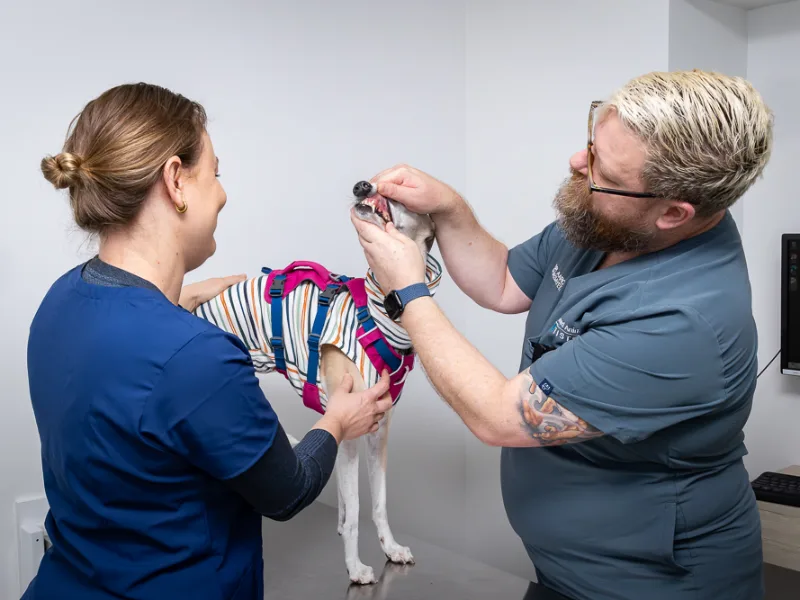
Sometimes, pets do genuinely seem fine before treatment, which is why dental issues can be so hard to spot without regular cleanings and assessment under anaesthetic. For example, a puppy with linguoverted mandibular canines can still appear perfectly happy, eating, playing and wagging their tail, even though those teeth are causing ongoing trauma to the roof of the mouth.
So what happens after treatment?
Once that contact is stopped, you can often still see a change. Maybe they’re easier to pat or settle than before. The point is, the benefits of better oral health aren’t always about extra energy. Sometimes, it’s better behaviour.
And then there’s a common concern among owners about how their pet, particularly a senior animal, might cope if they need multiple or even full mouth extractions. It sounds like a big loss and one that could negatively affect quality of life. But the opposite is often true. When we remove teeth, it’s because they’re severely affected by disease, and extraction is the best option. Sometimes owners are simply hoping their pet will learn to cope with fewer or no teeth, then are very pleasantly surprised to find they aren’t just coping. They’re thriving.
Actual recovery is faster than most owners expect
A mouth full of stitches does sound like it would entail a long and uncomfortable recovery. But in reality, most of our patients are back to normal within about 48 hours, sometimes even sooner. Of course, this depends on the condition and procedure. Some things to keep in mind if your pet is undergoing dental treatment in the near future:
- Once the initial recovery from surgery and anaesthesia has passed, genuine improvement isn’t too far behind. Many patients are eating and drinking normally within the first couple of days, and owners may already start seeing some of the positive changes we’ve talked about.
- You’ll go home with pain medication and instructions for giving it, and many owners find their pet seems quite comfortable well before the course is finished.
- More extensive procedures or conditions, like oronasal fistulas, oral tumours and jaw fractures, may require a longer recovery period and additional rechecks. Some patients may need monitoring for several weeks or even months, depending on the case.
“The benefits of better oral health aren’t always about extra energy. Sometimes, it’s better behaviour.”
Knowing what feeling good looks like
Once a pet has had their dental treatment, their families often get a new baseline for what their normal behaviour is when they’re feeling well. So when you start to see certain things creep back in, you know it’s time to have their oral health checked again.
If you only realise after treatment just how much your pet had changed, don’t be hard on yourself. Dental disease can be extremely subtle, and sometimes it takes seeing them feeling good again to understand how much they had adapted.
If you’re concerned about your pet’s dental health, or you’ve been told they need a procedure, contact the team at Advanced Animal Dentistry to learn more or speak with your regular vet.
For veterinary professionals, we’re available to help with complex dental cases, advanced assessment and treatment. You can refer a patient here.