Small teeth. Big influence on oral development for dogs. Not every malocclusion begins with an abnormal jaw. Some start with a baby tooth that never falls out. These retained or persistent deciduous teeth can force adult teeth to erupt in the wrong position, and this creates some serious positional problems that aren’t obvious at first.
And the challenge is that there is often only a small window of time where intervention can influence where those adult teeth ultimately end up.
At Advanced Animal Dentistry, we regularly assess and treat a range of complex oral conditions, including persistent deciduous teeth in pets. These cases often require careful evaluation of developing teeth, bite function and future oral health to determine the most appropriate course of action.
Why puppy teething can go wrong so quickly
Unlike the human process, which can take years, the mouth develops at an astonishing rate during puppyhood. Dogs and cats are born with no teeth, develop a full set of deciduous teeth, lose them and then erupt a full set of permanent teeth, all within the first six to seven months of life. This rapid turnover leaves little room for error during normal dental development.
What makes this process even more interesting is that while we understand how deciduous teeth are shed, we don’t fully know what triggers it. As part of the normal process, specialised cells gradually resorb the roots of baby teeth until they loosen and fall out. Many people assume adult teeth simply come along and push them out of the way, but that’s not always the case. Some deciduous teeth are lost without an adult tooth nearby, while others remain in place even as the permanent tooth begins to emerge.
When that happens, the adult tooth still has to erupt. The permanent tooth is forced to find an alternative path through the bone and gum. Instead of occupying its intended space within the mouth, it can end up somewhere entirely different.
"A puppy can develop a malocclusion despite starting with a completely normal bite if a deciduous tooth fails to fall out when it should."
How persistent deciduous teeth affect adult tooth position
The tricky part is that the persistent deciduous tooth is usually not the tooth that’s in the wrong place. Most of the time, it’s sitting exactly where it should be. As mentioned, the adult tooth still has to erupt and is the one forced to find another path around the persistent tooth. When canine teeth are involved, their size and importance to normal bite function mean even a small change can affect how the upper and lower jaws fit together.
While persistent deciduous teeth can affect several teeth within the mouth, canine teeth are by far the most common to remain behind.
What happens next depends on whether the persistent tooth is in the upper or lower jaw.
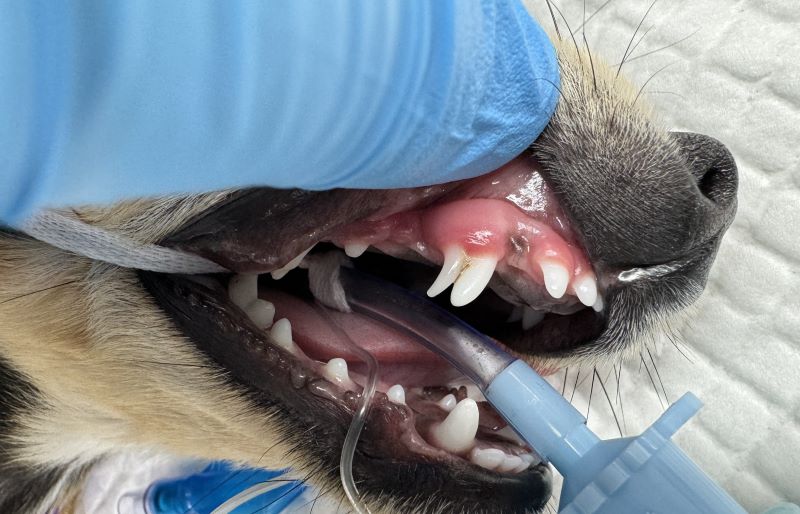
When an upper deciduous canine remains in place, the permanent canine will often erupt further forward than normal. This can reduce the natural gap that should exist between the upper canine and the front teeth, leaving less room for the lower canine to sit comfortably.
When a lower deciduous canine persists, the permanent canine typically erupts towards the inside of the mouth. This can place it closer to the palate and increase the risk of traumatic contact with the surrounding tissues.
But what may be most surprising to pet owners is that a puppy can appear completely normal while it still has its baby teeth. Unlike some malocclusions that are linked to jaw shape and are apparent early in life, these cases are not always present from the beginning. A puppy that initially had a normal bite can end up with a malocclusion simply because a deciduous tooth failed to shed when it should have.
There is a critical window for treatment
Between four and a half and five and a half months of age, when these teeth would normally be expected to loosen and fall out, is the most important time for identifying and treating persistent deciduous teeth. Unfortunately, it is also when many puppies have finished their vaccination schedule and are no longer making regular visits to the veterinarian. This means the issue is often not recognised until later.
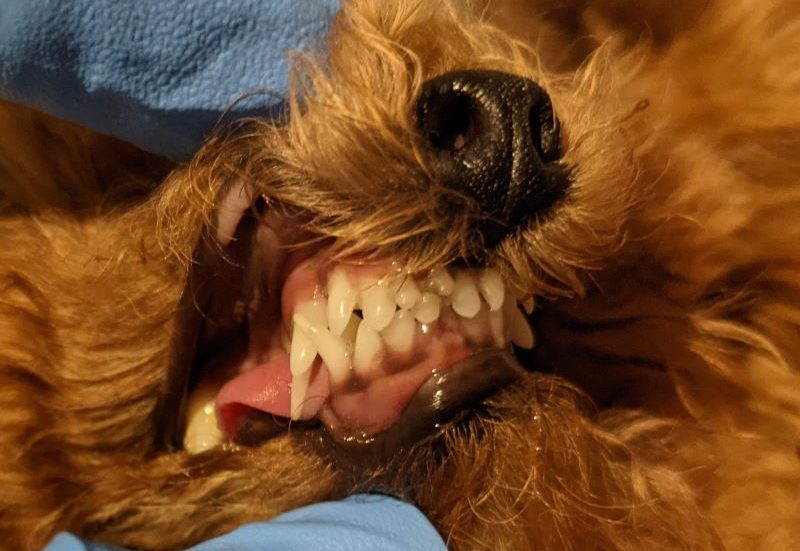
One of the most obvious signs is two canine teeth occupying the same space. Owners may see this and notice the small, needle-like deciduous tooth still present alongside a much larger adult tooth.
At this point, prompt assessment is essential. If the persistent tooth is removed while the permanent tooth is still finding its way into position, there is often an opportunity to move that tooth back into a more favourable position.
This window is very short. Once the permanent tooth has fully erupted, removing the persistent deciduous tooth may still be recommended for oral health reasons, but it isn’t likely to change where the adult tooth settles within the mouth.
Why persistent deciduous teeth should still be removed
While we can’t change the positioning of adult teeth past that critical window, extraction may still be recommended, just not for the purpose of correcting the bite itself.
Why? These teeth often sit extremely close to their permanent counterparts, which creates a narrow space where hair, food and other debris can become trapped. Over time, this encourages plaque accumulation and increases the risk of periodontal disease, local inflammation and infection.
I recently had an 11-month-old patient with persistent deciduous canine teeth in this situation. This pup was past the point where we could influence the position of the adult tooth with techniques like early extraction or ball therapy. However, debris was already gathering between the persistent and permanent teeth, which is why removal was still the best option for long-term oral health.
"The opportunity to influence adult tooth position is often limited to a very short stage of dental development."
A small tooth with lasting consequences
While baby teeth that overstay their welcome are not necessarily painful on their own, the malocclusions they can contribute to often are.
If you have a puppy and notice two teeth in one spot, adult teeth erupting alongside baby teeth or baby canines that have not fallen out, see your regular vet for an assessment and advice. Concerns about persistent deciduous teeth, delayed tooth loss or bite development are always worth discussing sooner rather than later.
Feel free to call us at Advanced Animal Dentistry or get in touch through our contact form. We’ll work closely with your primary vet to make sure your pet gets the care they need.
Vets can refer patients here.