
Ball Therapy

Ensuring your dog’s mouth is comfortable is crucial for their overall happiness. For those with linguoverted teeth, ball therapy offers a fun, non-invasive intermittent orthodontic intervention to improve pet dental health and wellbeing.

At Advanced Animal Dentistry, we believe every pet deserves to live their best life with their best smile. We are often asked about ball therapy. Here’s what you need to know about how it works and its benefits, how it compares to other treatments and how to choose the right ball.

Understanding Ball Therapy

Ball therapy isn’t suitable for all pets. It requires the right conditions to be effective and is not particularly useful for deciduous teeth or fully erupted permanent teeth. It is also only useful for a short period of time.

As an intermittent orthodontic intervention, ball therapy applies targeted force to move teeth, but unlike human braces, the force is applied periodically rather than continuously. We recommend ball therapy for dogs with linguoverted mandibular canines, a condition where the lower canines are angled too far towards the tongue, causing trauma to the roof of the mouth. By applying the appropriate force during the eruption of these teeth (typically between four and a half and five and a half months of age), we can guide them into a better, atraumatic position.

Ball therapy is a safe and non-invasive treatment for dogs, with no negative side effects even if it’s not successful.

In contrast to other treatments for linguoverted mandibular canines, many of which require the removal of part or all of the tooth to prevent trauma, ball therapy helps maintain the teeth without the need for extraction.

"Ball therapy gently tips base‑narrow lower canines outward — no anaesthetic, just structured, supervised play.”

About linguoverted mandibular canines

Linguoverted canine teeth in pets, also referred to as base narrow or inverted canines, are one of the most common orthodontic concerns we see in veterinary dental practice. It happens when the lower canine teeth are positioned too far inward, causing them to contact the soft tissue of the upper mouth.

This misalignment can result in significant discomfort and trauma, potentially leading to severe issues like oronasal fistulas, where a hole forms between the mouth and nasal cavity.

Treatment is tailored to the patient’s age, underlying cause and tooth position.

Alternative treatments for linguoverted canines include early extraction of the deciduous teeth or using a dental appliance to guide the eruption of the permanent teeth.

Removing the deciduous canines can relieve trauma to the soft tissue and allow the permanent teeth to erupt more naturally.

For erupted teeth, in addition to extraction, treatment options include gingivoplasty and crown extensions. Gingivoplasty reshapes the space between the upper third incisor and canine to guide the erupting lower canine into position, while crown extensions help tilt the teeth into better alignment.
Choosing the right ball

Choosing the right ball for ball therapy is essential to ensure the treatment is safe for the dog’s teeth and has the best possible chance of being successful.

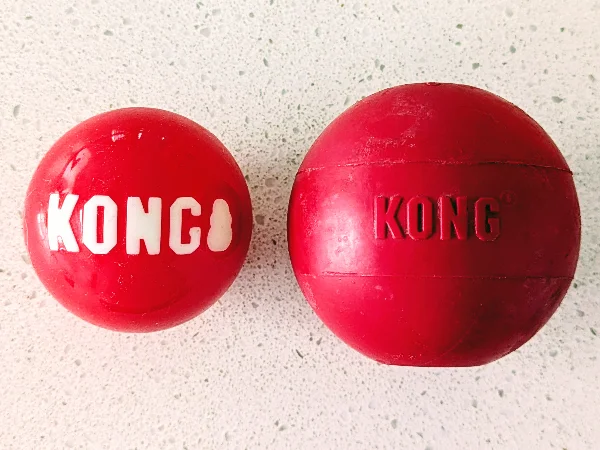
The ball should be made of dense rubber that is somewhat difficult for the dog to compress, like the rubber used in KONGs™. If it’s too easy to squash, it won’t apply enough force to move the canines. However, if it’s completely rigid (like hard plastic), it could damage the teeth.

The surface of the ball must be smooth to allow the teeth to slide over it. Any rough material can trap dirt when wet with saliva, which could then abrade and damage the teeth.

Size is also crucial. The ball needs to be just the right size—not too small, not too large. Ideally, it should be about 50% wider than the space between the lower canines.

"Start while the permanent lower canines are erupting for the best results and fewer invasive procedures later.”

Implementation Tips

Make ball therapy enjoyable for your dog by adding a fun element, such as spreading peanut butter on the ball or inside it. Encouraging your dog to chase and retrieve the ball can help keep them engaged while benefiting the therapy.

Tug-of-war is another great way to enhance the effectiveness of ball therapy. Using a ball with a rope through it encourages the dog to apply more force. Aim to perform ball therapy at least three times daily for 15 minutes each session.

Remember, ball therapy isn’t a solution for all cases of linguoverted canines. However, it is a low-risk intervention that can be effective for many dogs. It’s important to have the dog evaluated first to rule out other potential treatments or underlying issues.

Meet the Author

Aaron Forsayeth

BVSc (Hons) MACVSc (Veterinary Dentistry)

Hi, I’m Dr Aaron Forsayeth, and I’ve had quite the journey in veterinary medicine. Originally, I never imagined myself pursuing dentistry.
I spent my initial years in general practice until a chance meeting with Dr Gary Wilson changed my career path. He inspired me to explore veterinary dentistry, and together, we co-founded Advanced Animal Dentistry in 2006. It’s ironic, considering I used to dread dental procedures, but with the right knowledge and skills, it became a passion that I absolutely love to this day.

FAQs

What is “ball therapy” for dogs and what does it treat?

Ball therapy is an intermittent orthodontic technique where your dog holds a firm rubber ball between the lower canines to tip them outward. It’s used for puppies with linguoverted (base‑narrow) lower canines that contact the palate—see the overview on Ball Therapy and the condition page Linguoverted Canine Teeth

What age should I start ball therapy—and will it work once adult teeth are fully erupted?

The sweet spot is during eruption of the permanent lower canines (~4½–5½ months); it’s not useful for baby teeth or fully erupted permanent teeth—details in Ball Therapy and the clinic’s Ball Therapy handout (PDF).

Which ball should I use (and are tennis balls OK)?

Choose a dense rubber, smooth‑surface ball (KONG‑type) and size it to be about 50% wider than the space between the lower canines; avoid tennis balls (too squishy/abrasive) and hard plastic—see “Choosing the right ball” on Ball Therapy and the Ball Therapy handout (PDF)

How often should we do ball therapy and for how long?

Aim for three sessions a day of ~15 minutes, using play (fetch or a rope‑through‑ball tug) to maintain gentle lateral pressure—see the tips on Ball Therapy or download the Ball Therapy handout (PDF)

Is ball therapy safe—does it hurt?

It’s non‑invasive and considered safe; even if it doesn’t fully correct the bite there are no negative side‑effects—read more on Ball Therapy and book an assessment via Contact us if you’re unsure whether your pup is a candidate.

What are the next options if ball therapy isn’t enough?

Specialist options include interceptive procedures like Gingivoplasty and Inclined Plane / Crown Extensions, or definitive treatments such as Crown Height Reduction with Vital Pulpotomy (vital pulpotomy explained) or Mandibular Canine Extraction; if you think your puppy may need these, contact us

Key Takeaways

Time‑sensitive window

Ball therapy is effective only while the permanent lower canines are erupting (about 4½–5½ months); after this, fixed appliances or surgical options are usually required.

Non‑invasive first line

It’s a play‑based, low‑risk way to tip base‑narrow lower canines outward and prevent palate trauma in suitable puppies.

Right ball = better results

Use a dense, smooth rubber ball sized to be 50% wider than the gap between the lower canines. Avoid tennis balls and hard plastics.

Consistency matters

Aim for 15 minutes, three times daily (fetch or rope‑through‑ball), always supervised, with periodic checks to track progress.

Next steps

For Pet Owners

Are you concerned about your pet’s dental health? Call 1300 866 848 or fill out the contact form. We’ll coordinate with your primary vet to ensure the best outcome.

For Vets & Nurses

We’re here to help. If you’d like to refer a patient, please call us at 1300 866 848 , complete the referral form or email us with a brief case summary, relevant radiographs and lab results.

For advice and treatment guidance, email us with a brief case summary, relevant radiographs and lab results.


Refer a Patient Contact Us

Advanced Veterinary Dental Services

A comprehensive range of dental and oral surgery treatments.

Contact Us    Refer A Patient
Complex Anaesthesia

We assess each patient individually, considering their health history, age and any concurrent medical conditions, to tailor the anaesthetic approach to their specific needs.

Surgical Extractions

Removing complex teeth safely and with minimal impact.

Vital Pulpotomy

A vital pulpotomy is a time-sensitive procedure used to preserve the life of a tooth when the pulp becomes exposed due to trauma or dental treatment.

Jaw Fractures

Jaw fractures in pets require precise treatment to restore both structure and function, with a strong focus on proper bite alignment.

Periodontal Treatment

Periodontal treatment goes beyond routine dental care to address the deeper damage caused by advanced gum disease.

Oral Surgery

Pet oral surgery can help treat dental problems, injuries, and other conditions affecting your pet’s mouth. Learn about the available procedures and how they can improve your pet’s comfort and oral health.

Dental and Oral Imaging

Dental and oral imaging helps veterinarians identify dental problems that may not be visible during a routine examination. Learn how these imaging techniques support accurate diagnosis and effective treatment for your pet.

Root Canal Therapy

Root canal therapy can help save a damaged or infected tooth while relieving pain in pets. Learn how this dental procedure works and how it can help preserve your pet’s natural teeth and oral health.

Gingivoplasty

This procedure involves reshaping gum tissue to guide the eruption of canine teeth into a correct position, preventing traumatic occlusion and avoiding more invasive treatments.

Crown Height Reduction

Reducing the height of misaligned canine teeth and protecting the exposed pulp with a filling helps prevent chronic pain, preserve jaw structure and avoid extraction.

Inclined Plane – Crown Extensions

Orthodontic appliances like inclined planes or crown extensions can reposition misaligned canine teeth, preventing trauma and preserving tooth function without altering their shape.

Dog Braces (Orthodontics)

To address mesioverted  (‘lanced’ maxillary canine teeth) and manage linguoversion when the maxillary diastema (the space between the third incisor and canine teeth) is too narrow.

Restorations

Restorative dentistry repairs damaged teeth in pets, often using crowns, veneers and fillings. These procedures restore dental structure and function, ensuring long-term oral health.

Professional Dental Cleaning

Thorough cleaning and examination under anesthesia remove plaque and calculus, preventing periodontal disease and ensuring long-term oral health in pets.

Mandibulectomies and Maxillectomies

These surgeries involve partial or complete removal of the jaw to treat malignant oral tumours. Treatment options vary and may include surgery, chemotherapy or radiation.

Crown Amputation for Tooth Resorption

This procedure, often used for tooth resorption, involves removing the tooth crown while leaving the resorbing root remnant intact. It’s less invasive and used in cases where traditional extraction is no longer possible. Regular follow-up is recommended.












